REVIEW · WORKSHOPS
Hanoi Knife Making Traditional Workshop
Book on GetYourGuide →Operated by Vietnamtravelers · Bookable on GetYourGuide
A trip to Da Sy village feels like time travel, but your hands stay in the present. This 3-hour Hanoi knife-making workshop puts you at a real forging village and guides you from sketching a blade to sharpening the finished knife. I love that you’re not just watching, you’re doing real steps, and I love the small details—like the guided choice of your knife design and the tar-based chemical wash used during sharpening. One thing to think about: you’re in a workshop with metal tools, heat, and a safety-focused approach, so it’s not the kind of hands-on class where you freestyle every second.
You’ll also appreciate how the English-speaking guide and the master craftsperson keep things clear and friendly. In several sessions, guides like Tee and Nathan have handled translation well and kept the pacing fun, not stressful. That structure matters because knife making has a rhythm—hammering, shaping, then the final sharpening—so you’ll know what you’re doing and why it matters.
The only real drawback is the safety and skill balance: some steps are done by the master, especially the parts involving riskier machinery. You can still get plenty of hands-on time, but if you expect 100 percent of the process to be fully DIY, you may find it a bit more guided than you hoped.
In This Review
- Key highlights worth marking on your day
- Knife making at Da Sy: what you’ll actually learn
- Getting to the village: pickup, timing, and what to expect
- Choosing your knife: the design moment before the heat
- Forging the blade: from embers to hammer rhythm
- Shaping, handle work, and getting the form right
- Sharpening on the grindstone: the step that makes it work
- The knife you take home: souvenir value that actually earns its place
- Price and value: what $50 gets you in time, work, and transport
- Who should book, and who should skip or adjust expectations
- Practical tips before you go
- Should you book the Hanoi knife-making workshop in Da Sy?
- FAQ
- How long is the Hanoi Knife Making Traditional Workshop?
- Where does the class take place?
- Is pickup included from Hanoi hotels?
- Is there an English-speaking guide?
- What will I do during the knife-making process?
- Will I be able to make the knife myself, or is it mostly done by the master?
- What is included in the price?
- What should I wear or bring?
- Are there any restrictions during the workshop?
- Are there any extra charges on holidays?
Key highlights worth marking on your day
- Da Sy village forging craft: practice a tradition that dates back centuries and now makes agricultural tools
- Choose your knife design: pick from options and shape your own plan before the work starts
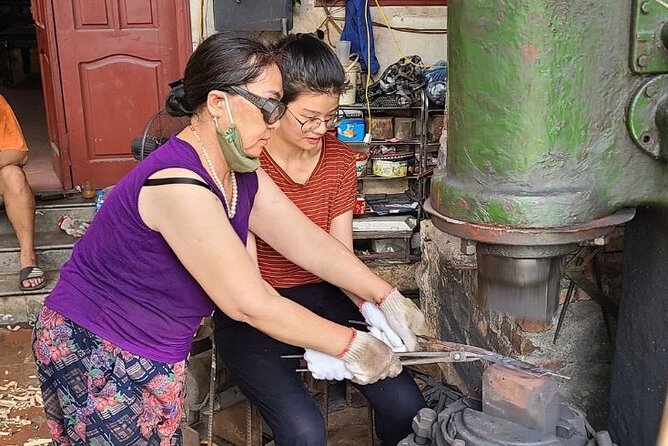
- Hands-on forging and shaping: hammering and blade shaping with supervision from the master
- Safety-first workshop rhythm: you do lots yourself, while the craftsperson handles the most dangerous steps
- Sharpening includes a family-style tar wash: a key step used during the grindstone process
- Take home a practical souvenir: you leave with a usable, handmade knife
Knife making at Da Sy: what you’ll actually learn
Da Sy village sits on the outskirts of Hanoi and is known for forging work. Long ago, the craft helped create weapons; today, the tradition continues through metalwork that supports daily life, including agricultural implements. What you’ll feel in the workshop is that this is not a performance. It’s a working craft passed down through families—so the pace is practical, the tools are real, and the teaching is aimed at getting you to a finished object.
The class centers on making a simple knife, step by step. You’ll start with design—sketching the blade shape on metal—then you’ll go through forging, shaping, and sharpening. The sharp part isn’t just the final result. It’s understanding how each step affects the next: how you cut and form the blade, how shaping refines the edges and proportions, and how the grinding and treatment lead to a working tool.
If you love cooking, tools, or hands-on crafts, this is one of those activities where you’ll start paying attention to details you usually ignore—how metal is handled, how the blade geometry matters, and why the last minutes of sharpening determine how the knife feels.
You can also read our reviews of more tours and experiences in Hanoi



Getting to the village: pickup, timing, and what to expect
This is a hotel pickup experience. You’ll wait in the lobby about 5 minutes before your pickup time, and then you’ll travel out to the village with an English-speaking guide. The workshop itself runs about 3 hours, but exact start times vary based on availability.
This matters more than you might think. Hanoi traffic can be unpredictable, so having a planned pickup keeps you from burning half your morning just trying to get out of the city. Also, the ride gives you context—your guide may share background on local history and village life, which helps the craft feel grounded instead of random.
Group size is kept small when you book a small group option. That usually means less standing around and more chances to ask questions, especially when you’re learning safety rules and the right way to hold tools.
Choosing your knife: the design moment before the heat
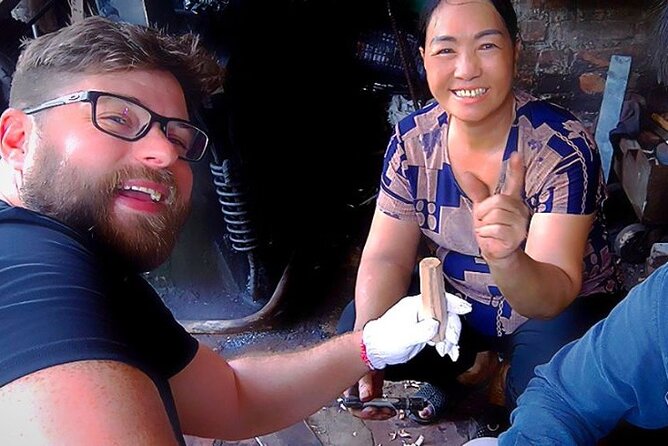
Before anything gets hot, you choose your knife type. You may be able to select from design options, and some classes let you choose from photo references or the style you want. This step is part practical planning and part mood-setting. When you pick the knife, you’re committing to a shape and a purpose, not just following a template.
Then the workshop moves to the material side: you’ll begin by sketching the blade shape on a sheet of metal. The metal matters here. The class uses a type of metal selected for durability, so the design isn’t just decorative. It’s the blueprint for how the blade will perform after forging and sharpening.
One nice detail is that the design choice keeps the workshop personal. Multiple guides have emphasized that you’ll get help choosing and that you’ll see your preferences reflected in the final knife.
Forging the blade: from embers to hammer rhythm
The forging part is where the workshop becomes memorable. You’ll work with the maker to cut out the blade and tang. The tang is the part that extends into the handle, and it’s what makes the knife functional when it’s assembled.
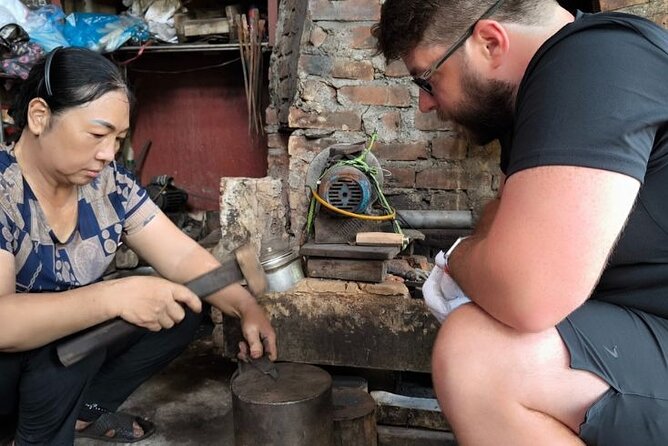
In the process, you’ll use tools like a hammer, cutter, and anvil. The cut metal is thrust into crackling embers, then shaping begins through alternating blows with the maker. You’re not expected to be a blacksmith. The goal is that you can participate while the craftsperson guides you into correct technique and safe movement.
A key detail is how the workshop handles imperfections. After shaping, trimming can happen using a hydraulic cutting machine. That’s one of the moments where you’ll see the line between what you do and what the master controls—because it’s faster and safer for some of the precision work.
If you’re worried you’ll do almost nothing, don’t be. Most participants get hands-on time at multiple steps, including hammering and shaping under supervision. But you should also assume the master will keep control of the riskier stages.
Shaping, handle work, and getting the form right
Once the blade has a rough shape, the workshop focuses on refinement. Shaping is about getting proportions right: edge lines, thickness, and overall balance. You’ll work alongside the maker, often trading blows or adjusting technique based on what you see.
Some classes also include helping with handle shaping, so you’re not just forging metal and then watching. If you get the chance to work on the handle, you’ll probably feel how small changes in the handle affect comfort and control. That’s also why the final knife feels like a souvenir you can actually use, not a decoration.
Safety stays front and center. Even when you’re hands-on, you’ll be coached on how to position your body and where your hands go. Comfortable shoes are a must because you’ll likely be standing for stretches and moving between work areas.






Sharpening on the grindstone: the step that makes it work
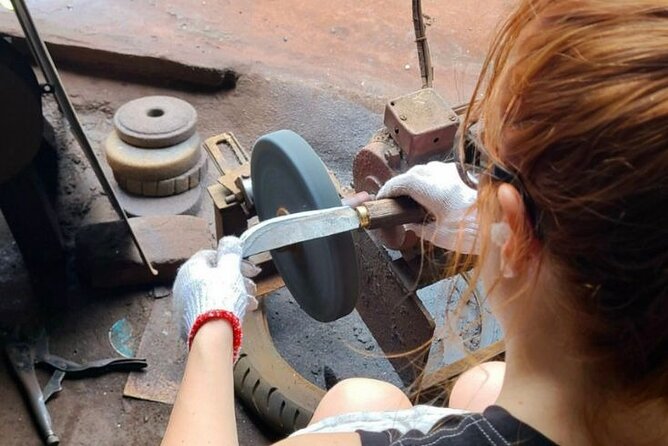
Forging builds the knife. Sharpening makes it usable.
The workshop includes sharpening on a grindstone and describes phases within that process. One of the standout details is that sharpening includes soaking the blade in a special tar-based chemical wash. The class treats this as a family recipe, so it’s not something you just see once and forget. It’s part of how the blade is prepared before and during the grindstone work.
After the grinding phases, you end up with a blade that should feel noticeably sharp. Many people leave excited about that moment because it’s when the object transitions from metalwork to a functioning knife. If you care about the difference between a sharp edge and a polished one, this workshop gives you the full sequence instead of jumping to the final product.
The knife you take home: souvenir value that actually earns its place
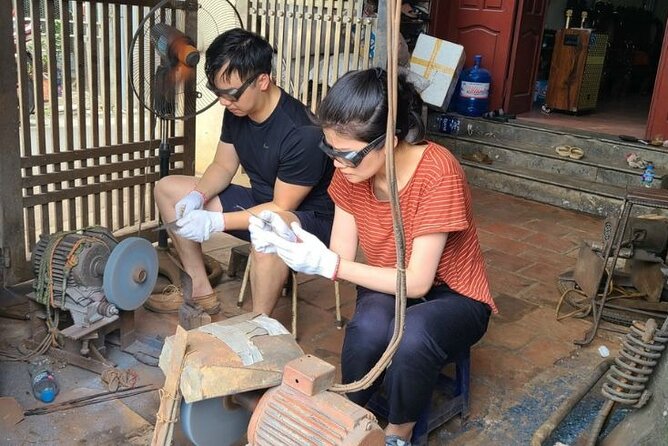
At the end, you keep the knife. That’s a big part of the value because you’re not paying for a demo. You’re paying to leave with something finished from start to end: blade and handle work, plus the sharpening that makes it practical.
The knife also becomes a real conversation starter. It’s a tool made with local craft methods, taught in English, and shaped by your choices. For gift-giving, it’s one of those rare souvenirs that feels personal and useful at home, not just collectible.
One practical note: you should treat your new knife like a real tool—handle it carefully, keep it in a safe place during your trip, and don’t expect it to behave like mass-produced knives. Handmade knives can have a slightly different feel, and that’s part of the charm.
Price and value: what $50 gets you in time, work, and transport
$50 for about 3 hours is not just a craft fee. You’re also getting hotel pickup, an English-speaking guide, equipment support, and instruction from a master craftsperson. The workshop includes the process from design to a sharpened knife, which is why the experience tends to feel like more than the sum of its parts.
Here’s how I’d judge value if you’re deciding between a few Hanoi activities:
- If you want to see metalwork history as a story only, you might find cheaper options.
- If you want a practical outcome—your own knife—plus transport and guidance, this is one of the more direct value plays in the city.
Also, the class time is compact. You’re not losing half a day to transit and waiting. In a place like Hanoi where you might already plan multiple stops, that matters.
Who should book, and who should skip or adjust expectations
This workshop is ideal if you want a hands-on craft that stays beginner-friendly. Several guides described the class as suitable for true beginners, and you don’t need prior DIY skills. You’ll learn by doing with supervision, and you’ll get clear translation and instructions.
It’s also a great option if you travel with teens. The work is visual and physical, so it doesn’t feel like a lecture. And if you like food, tools, or cooking, you’ll probably appreciate leaving with kitchen-ready sharpness.
What might not fit:
- If you expect a workshop that lets you control everything yourself end-to-end, you may feel the master takes the lead on the riskiest machinery step.
- If you have mobility limits or safety concerns, you’ll want to think carefully. The activity isn’t for people over 95, and it’s not set up for alcohol or drugs, which signals the focus on keeping the work controlled.
Practical tips before you go
Bring comfortable shoes. That’s the main item on the list, and it’s worth taking seriously because this is a standing, moving, hands-on workshop.
If you’re sensitive to safety limits, ask your guide during the session how much you can do personally. Some formats give you a choice between doing everything yourself versus doing some steps while the master handles the rest. Either way, you’ll still learn the full process.
Finally, plan your day with a little margin. Even though the duration is 3 hours, you’ll want comfortable time before and after so you can travel back smoothly and safely store your new knife.
Should you book the Hanoi knife-making workshop in Da Sy?
Book it if you want a real skill-based craft experience with a tangible payoff. The biggest strength is that you’ll go through the steps—design, forging, shaping, and sharpening—and you’ll take home a knife you actually made. It’s also a strong choice for first-timers because the guidance and translation are part of the setup, with guides like Tee, Nathan, Khoi, and Minh mentioned for making the experience smooth.
Skip it or adjust expectations if you’re looking for total self-guidance with no safety-controlled handoffs. The workshop is hands-on, but it’s also careful, and some equipment steps are handled by the master.
If you want one memorable, local, practical activity outside Hanoi’s busiest rhythm, this is the kind of morning that sticks. You’ll leave with a story you can show, and a knife that proves the work was real.
FAQ
How long is the Hanoi Knife Making Traditional Workshop?
The workshop duration is listed as 3 hours. Starting times vary, so it’s best to check availability for the slot you want.
Where does the class take place?
The workshop is in Dong Bac, Vietnam, in the Da Sy village area outside Hanoi, known for forging craft work.
Is pickup included from Hanoi hotels?
Yes. Pickup is included, and you’ll be picked up from your hotel. Plan to wait about 5 minutes in the hotel lobby.
Is there an English-speaking guide?
Yes. The instruction and live tour guide are listed as English.
What will I do during the knife-making process?
You go through the main stages: design (sketching the blade on metal), forging (cutting and shaping with a hammer and anvil in embers), shaping (including trimming and refinement), and sharpening on a grindstone.
Will I be able to make the knife myself, or is it mostly done by the master?
You’ll be hands-on for many steps under supervision. The workshop notes that the master is involved, and some steps involving dangerous machinery may be handled by the craftsperson while you participate in other parts.
What is included in the price?
Included items are English-speaking instruction, a 500ml bottle of water, the master, equipment, and products.
What should I wear or bring?
Wear comfortable shoes. That’s the only required item listed.
Are there any restrictions during the workshop?
Alcohol and drugs are not allowed.
Are there any extra charges on holidays?
Yes. There is a $10 surcharge on New Year and Tet holidays, Liberation Day/Reunification Day (30/4), International Workers’ Day (01/05), and National Day (02/09).