
REVIEW · CITY TOURS
3 Hours Hanoi City Walking Tour with Optional Train Street
Book on Viator →Operated by HNK Vietnam Travel & Tour Hanoi · Bookable on Viator
3 hours in Hanoi can feel like a week, and this walk is built for exactly that pace. I love how you cover major Old Quarter landmarks without rushing through everything, and I also like the structure that turns street corners into a quick lesson about Hanoi’s changing economy and French-era influence. One consideration: it’s still a walking tour in busy areas, so if you hate crowds or need long breaks, plan for a slower rhythm at stops like Railway Alley.
You’ll join a small group (up to 30 people) with an English-speaking guide, and you can choose between morning and afternoon options. The pricing is $26 per person, and it includes hotel pickup from the Old Quarter plus bottled water. If you’re curious about the famous Hanoi train street, the tour gives you a simple choice: pass by or pause for a coffee break at Duờng Tau.
In This Review
- Key highlights to expect
- Why this 3-hour route works in Hanoi’s Old Quarter
- Getting picked up on Hanoi’s Old Quarter side
- Old Quarter stops that teach you the city’s shape fast
- Dền Ngọc Son and St. Joseph’s: religious Hanoi, French Hanoi
- Duờng Tau (Train Street): pass through or pause for coffee
- Dong Xuan Market and the Old City Gate at O Quan Chuong
- Price and value: what $26 includes (and what it doesn’t)
- Who this Hanoi walk suits best
- Should you book this Hanoi walking tour?
- FAQ
- Where does the tour start?
- Is hotel pickup included?
- How long is the tour?
- Does the tour include tickets to the sights?
- What is the Railway Alley stop like?
- Are there morning and afternoon options?
- Does the price include a guide and water?
- Will there be food or snacks included?
- Is drop-off included at the end?
Key highlights to expect
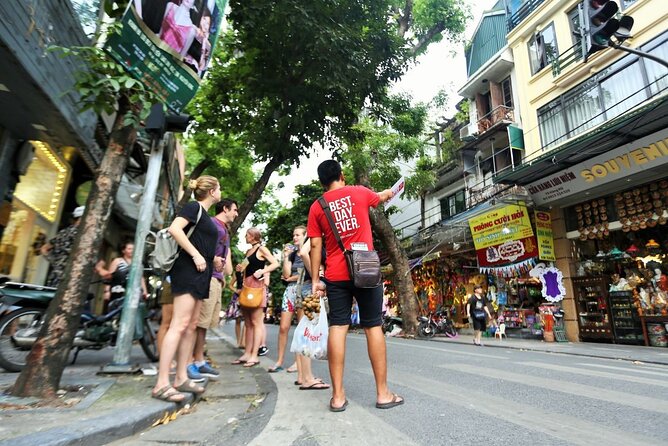
- Hotel pickup in Hanoi’s Old Quarter (and a smooth end near where you started)
- Railway Alley / Duờng Tau: watch trains in motion and decide to linger or just pass by
- Free entry at each stop listed in the route (temples, cathedral, market, gate)
- A guided timeline feel for how Hanoi changed across decades, including French influence
- Compact 3-hour sweep of Old Quarter culture, architecture, and landmarks
- Bottled water included, so you won’t start the heat thirsty
Why this 3-hour route works in Hanoi’s Old Quarter
This tour is short by design: about 3 hours, so you get a concentrated hit of the Old Quarter’s best-known sights and a few calmer corners where you can actually look around. The route is paced around “see it, learn it, keep moving,” which is great if you’re only in Hanoi for a couple days or you want a first-orientation walk.
What makes it useful is the mix of types of places. You’re not just seeing buildings and snapping photos—you’re moving through spaces that help you understand Hanoi’s layers: traditional life in the Old Quarter, religious sites, French colonial architecture, and the daily rhythm of markets.
The other reason this works is that it’s flexible. Morning and afternoon tours let you match your energy level and the light you prefer for photos. And Railway Alley is handled with a choice: you can get your glance-and-go moment or you can slow down with a drink.
If you’re the kind of person who likes to end the day with a clear sense of where things are, this kind of route is a smart start.
You can also read our reviews of more walking tours in Hanoi



Getting picked up on Hanoi’s Old Quarter side
Logistics matter in Hanoi, and this tour tries to keep it easy. Pickup is offered from hotels located in the Hanoi Old Quarter only, which means you won’t be trekking across town before the walking even starts.
The meeting point is at 24B P. Lý Quốc Sư, Hàng Trống, Hoàn Kiếm, Hà Nội 10000, Vietnam. The tour also finishes in the Old Quarter area, and the guide will help you get back to your hotel—if there’s only one group, you walk back with the guide. If there’s more than one group, the tour doesn’t include drop-off.
So here’s the practical takeaway: if your hotel is outside the Old Quarter, double-check whether pickup applies to your exact location. If you’re in the Old Quarter, you’ll likely enjoy how quickly you can get started without wasting time on taxis.
Also, build a little buffer. The Old Quarter can be slow on foot and chaotic near pickup points, and the difference between arriving 5 minutes early and 10 minutes late can feel bigger than it should.
Old Quarter stops that teach you the city’s shape fast
The Old Quarter is where Hanoi’s identity gets loud. The first part of the walk is built to help you connect street layout with everyday life and older traditions.
Old Quarter pick-up comes first, then you head to a small cluster of sites that introduce the “why” behind the neighborhood. The Hanoi Old Quarter Culture Exchange Center is a quick stop where you’ll see documents and older papers that explain how Hanoi has changed over thousands of years. It’s not a long museum visit; it’s more like a set of context cards that makes the rest of the walk easier to read.
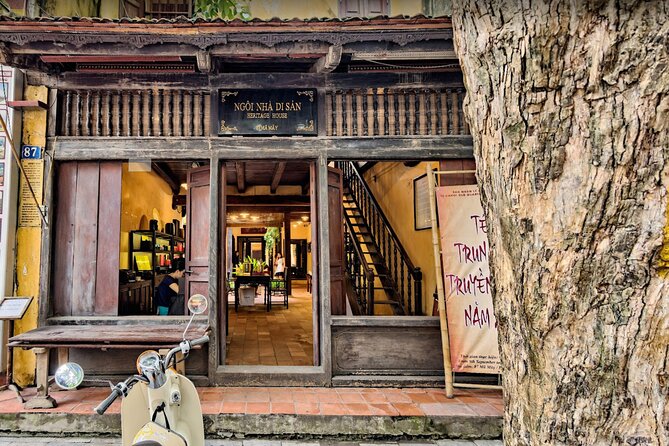
Next is the Ancient House, focused on a typical kind of tube house architecture in Hanoi. If you’ve never seen one of these tight, long homes, this stop gives you a visual answer to a simple question: how did people fit family life into dense Old Quarter streets?
Then comes Kim Ngan Temple, one of the older temples in the Old Quarter. The tour frames it through history: built in the 15th century during the Lê Dynasty, tied to the silver-making craft ancestor. It’s a useful reminder that the Old Quarter wasn’t just commerce in general—it often organized around specific trades.
Two things I like about this first stretch:
- You get architecture + craft history early, so later landmarks feel less random.
- The time at each stop is short (around 15–20 minutes), so you keep momentum without feeling trapped.
The only drawback is that if you’re the type who wants deep time at each place, you’ll need to plan a longer follow-up after the tour ends.
Dền Ngọc Son and St. Joseph’s: religious Hanoi, French Hanoi
After the trade-and-architecture start, the tour shifts into religious landmarks—then into French-era influence. It’s a contrast that makes Hanoi’s layers feel real.
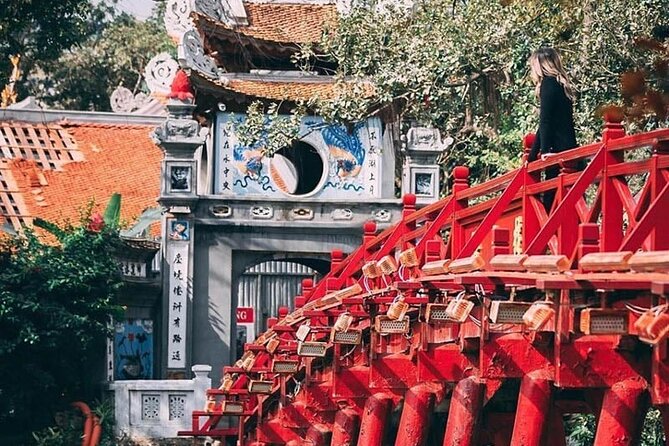
At Dền Ngọc Son, you’ll visit the Ngọc Son Temple area. The tour describes it as being erected in the 19th century to commemorate Trần Hưng Đạo, known as a major military commander of the Trần Dynasty. It also connects to Văn Xương Đế, which adds another thread to the site’s cultural meaning. This is the kind of stop where you can slow down and look at details because the site is meant for lingering, not speed.
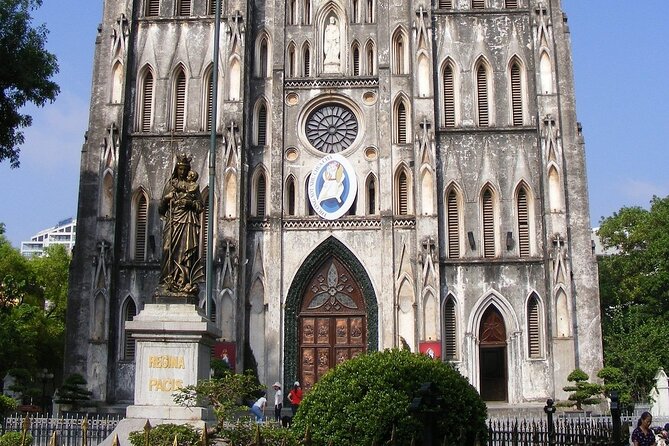
Then you’ll move to St. Joseph’s Cathedral, introduced in the tour as originally built by the French during a period of conflict, and today presented as a historical attraction that reflects French colonization. Even if you don’t care about architecture in a technical way, it helps you notice how colonial-era styles became part of Hanoi’s cityscape.
This section is valuable because it answers the question you’ll be asking all day: how did Hanoi go from older layers of local life to a city shaped by foreign power?
One caution: cathedral and temple areas can attract lots of foot traffic. Dress respectfully and keep your attention on the guide’s timing so you don’t get left behind while trying to take photos from the perfect angle.
Duờng Tau (Train Street): pass through or pause for coffee
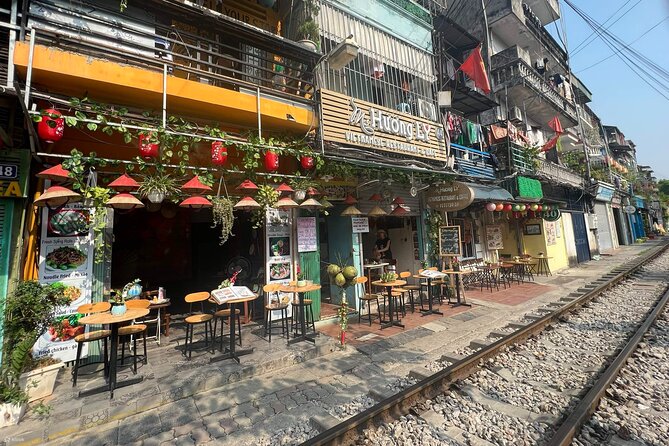
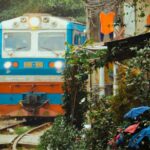
This is the star stop for most people. Duờng Tau (Railway Alley) is described as a place where trains still run every day. The tour is explicit about your options: you can simply pass by, or you can rest and enjoy drinks there.
What I like about that choice is that it respects different comfort levels. Some people want the photos and the big “only-in-Hanoi” moment and then move on. Other people want to sit near the action, watch how the alley works in real life, and take breaks while still feeling part of the street scene.
Practically, you’ll spend about 30 minutes at this stop. That’s usually enough time to:
- see trains pass while you’re in a safe viewing spot,
- take pictures,
- and grab a coffee/drink without feeling like the entire tour stops for one attraction.
The key consideration here is safety and awareness. Trains operate through the alley, so follow the guide’s instructions on where to stand and when to move. Don’t try to outsmart the moment for a better shot.
If you’re sensitive to crowds or noise, this is still workable—just pick the pass-by option and move on when the group needs to keep rolling.
You can also read our reviews of more city tours in Hanoi





Dong Xuan Market and the Old City Gate at O Quan Chuong
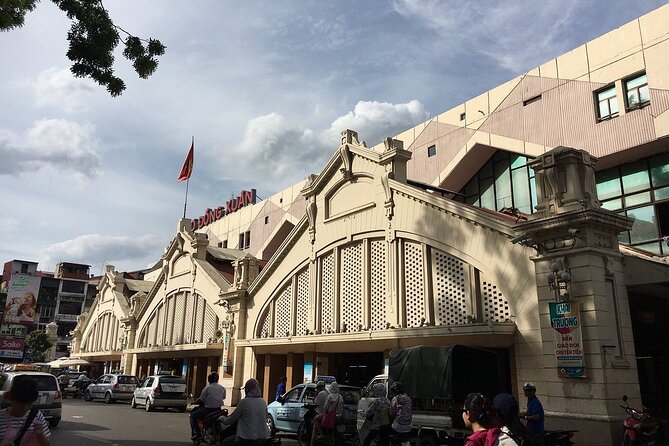
The last stretch gets you back into daily Hanoi: shopping, food ingredients, and a symbolic city boundary.
At Đồng Xuân Market, the tour frames it through what local people buy—ingredients, food, and herbal medicine. It’s also positioned as a place where you can find good prices. Even if you don’t shop heavily, the value is in seeing how locals use the market. You’ll feel the city’s practical side, not only the postcard sites.
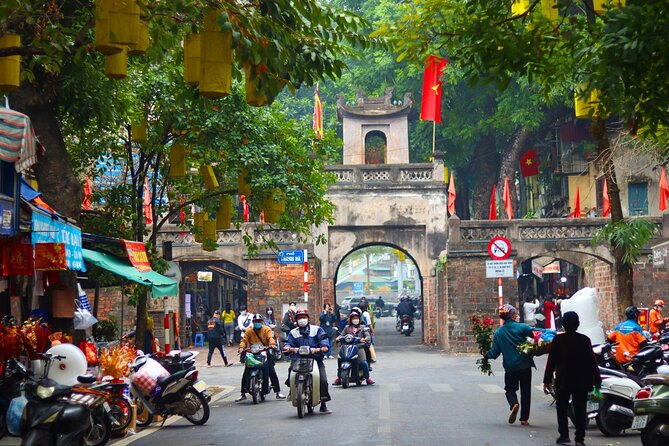
Then you finish at the Old City Gate, described as the last old gate to enter the Thăng Long Citadel. The specific reference is Old East Gate (O Quan Chuong), and the tour points out that it’s worth your attention not just historically, but because of how it connects to daily life in Hanoi.
This combo works well as a finish. Markets give you something to look at and compare, and the gate gives you a sense of where the city’s older boundaries were. It’s a clean ending that helps you orient yourself for later exploring.
One small tip: if you’re tempted to linger at Dong Xuan, do it fast. The tour is built around specific timing, and you’ll want to stay aware of where your group is heading next.
Price and value: what $26 includes (and what it doesn’t)
At $26 per person for about 3 hours, the value is mainly in the “guided access” part. You’re paying for:
- an English-speaking guide,
- hotel pickup from the Old Quarter,
- bottled water,
- and landing/facility fees,
- plus the listed stops being marked as free admission.
That’s a pretty fair deal for a route that hits multiple landmarks in different categories: temples, a French-era cathedral, an Old Quarter historical center, a market, and the Old East Gate.
What isn’t included is equally important. Snacks, food, and anything not mentioned are on you. And there’s no guaranteed drop-off if the tour has more than one group. So if you plan to eat after, give yourself time and walk a bit—this tour doesn’t promise a meal break.
If you’re adding drinks at Duờng Tau, that’s also for you to pay for directly. The stop is designed for a coffee break, but the tour price won’t cover your order.
Finally, check the tour’s group size (max 30). If you’re someone who likes quieter walks, you might still find this lively, especially around the center of the Old Quarter.
Who this Hanoi walk suits best
This tour is a strong fit for:
- first-timers in Hanoi who want the Old Quarter to make sense fast,
- people who like a structured route (short stops, clear progression),
- anyone who wants Railway Alley without turning the whole day into planning and logistics.
It’s also a good choice if you don’t want to spend hours in museums. The historical context is delivered in smaller, digestible pieces, so you keep moving and stay engaged.
If you’re coming with kids or you need to slow down often, it may feel a little tight. Each stop is roughly 15–30 minutes, with most around 20 minutes. That structure is excellent for many people, but not ideal for anyone who wants to linger for 45–60 minutes per location.
One more practical note from real-life experience in cities like this: wear comfortable shoes. The tour is mostly walking, and the Old Quarter is rarely smooth underfoot.
Should you book this Hanoi walking tour?
If you’re visiting Hanoi for only a short time, I’d say yes. This is the kind of tour that gives you a real sense of direction—geographic and cultural—without draining the whole day. You get a guided mix of Old Quarter history, religious landmarks, and the French-era contrast, with Duờng Tau as an optional pause point rather than a forced, all-or-nothing stop.
Book it if:
- you’re staying in the Old Quarter area,
- you want an organized 3-hour plan,
- you want Railway Alley handled in a way that still leaves room to rest.
Skip it (or adjust expectations) if:
- you hate crowds and noise,
- you need very long breaks between sights,
- you prefer to explore independently without timed stops.
Also, if you care about making the day smoother, try to arrive at the meeting point with a bit of extra time. Hanoi waits for no one, and the tour is short enough that delays matter.
FAQ
Where does the tour start?
The meeting point is at 24B P. Lý Quốc Sư, Hàng Trống, Hoàn Kiếm, Hà Nội 10000, Vietnam. You also may be picked up from hotels in the Hanoi Old Quarter.
Is hotel pickup included?
Yes. Pickup is included from hotels located in Hanoi’s Old Quarter only.
How long is the tour?
It’s about 3 hours.
Does the tour include tickets to the sights?
The listed stops show admission as free, and the tour also includes landing and facility fees. Snacks or extra paid items are not included.
What is the Railway Alley stop like?
You’ll visit Duờng Tau (Railway Alley) where trains still run daily. You can choose to pass by or stay to rest and enjoy drinks (coffee break style).
Are there morning and afternoon options?
Yes, there are both morning and afternoon tour options.
Does the price include a guide and water?
Yes. The tour includes an informative English-speaking guide and bottled water.
Will there be food or snacks included?
No. Snacks, food, and anything not mentioned are not included.
Is drop-off included at the end?
Drop-off services are not included if there is more than one group. If there is only one group, the tour includes walking back your hotel with you.
You Might Also Enjoy


More Walking Tours in Hanoi


More Tours in Hanoi
- Ninh Binh Full-Day Tour from Hanoi to Hoa Lu, Tam Coc & Mua Cave Via Boat & Bike
★ 5.0 · 4,384 reviews