REVIEW · HANOI CITY TOURS
Full-Day Hop On Hop Off Bus Tour in Hanoi
Book on Viator →Operated by ANH VIET HOP ON - HOP OFF VIET NAM · Bookable on Viator
Hanoi, in a single ride. This hop-on hop-off overview strings together 14 big sights so you can decide what to linger on, and I love the WiFi and air-conditioning as I jump between cathedrals, the citadel area, pagodas, and museums. One catch: the route can change due to traffic or weather, and it can take a bit of time to locate certain stops and get tickets verified at the meeting point.
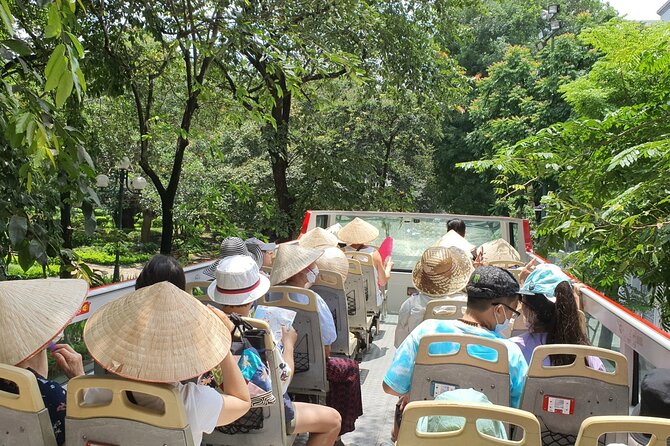
I also like that the tour comes with a practical onboard setup: a city map, bottled water, and even a conical hat plus a rain coat. The operator is trying to cut plastic by providing a 20-liter water container for refills, so bring a reusable bottle if you can.
In This Review
- Quick hits before you board
- Price and logistics: what $20 covers (and what it doesn’t)
- Where the bus actually starts: Dong King Nghia Thuc Square meeting point
- Comfort matters in Hanoi heat and rain
- Stop-by-stop: how to plan each hop for maximum value
- 1) St. Joseph Cathedral: French-era architecture you can enjoy fast
- 2) Vietnam Military History Museum area and the Flag Tower detail
- 3) Ho Chi Minh Mausoleum and Ba Dinh Square: a political center you can’t ignore
- 4) One Pillar Pagoda: minimal fee, iconic shape, quick payoff
- 5) Tran Quoc Pagoda: old Hanoi with serious age
- 6) Cua Bac Church area: French planning meets Roman Catholic life
- 7) Quan Thanh Temple: Taoist symbolism and the Four Sacred Temples idea
- 8) Imperial Citadel of Thang Long: independence in layers
- 9) Temple of Literature: Confucius plus Vietnam’s first national university
- 10) Hoa Lo Prison: the “Hanoi Hilton” gatehouse museum
- 11) Vietnamese Women’s Museum: social change told through artifacts
- 12) Hanoi Opera House: French elegance built between 1901 and 1911
- 13) Hanoi Post Office: the “Post office by the lake” symbol
- Audio, schedules, and what to watch for when things get messy
- Who this tour is best for (and who should choose something else)
- Should you book this Hanoi hop-on hop-off bus tour?
Quick hits before you board

- English audio that helps you make sense of Hanoi’s mix of French colonial, imperial, and revolutionary sites
- Air-conditioned bus + onboard WiFi for the hottest parts of the day (and for quick map checks)
- Conical hat and rain coat included, plus refillable water using a large container
- Some major stops are free (like St. Joseph Cathedral and One Pillar Pagoda) so your budget stays flexible
- Plenty of built-in walking points, meaning you can hop off, then stroll for photos and side streets
- Entrance fees vary at several attractions, so plan to pay at specific stops if you want inside access
Price and logistics: what $20 covers (and what it doesn’t)

At $20 per person for an approximate full day, this is a solid “first-day harness” for Hanoi. You’re paying for the ride, the hop-on hop-off freedom, and the onboard comforts: air-conditioned vehicle, WiFi, insurance coverage on the bus, bottled water, and a city map. There’s also a mobile ticket, and the tour is offered in English.
What’s not included is the fun part you might want to pay for once you’re there. Several sights have separate entrance fees (in VND), and the tour explicitly lists them for key stops like the Flag Tower area/Thang Long, Hoa Lo Prison, Temple of Literature, and the Women’s Museum. The good news is that two standout spiritual stops—St. Joseph Cathedral and One Pillar Pagoda—are listed as having no entrance fee, so you can stack “must-sees” without extra ticket lines.
My practical take: treat this as a cost-saver on transportation and time, then budget a little extra for inside visits if you want maximum value out of the day.
You can also read our reviews of more tours and experiences in Hanoi
- Ninh Binh Full-Day Tour from Hanoi to Hoa Lu, Tam Coc & Mua Cave Via Boat & Bike
★ 5.0 · 4,384 reviews


Where the bus actually starts: Dong King Nghia Thuc Square meeting point
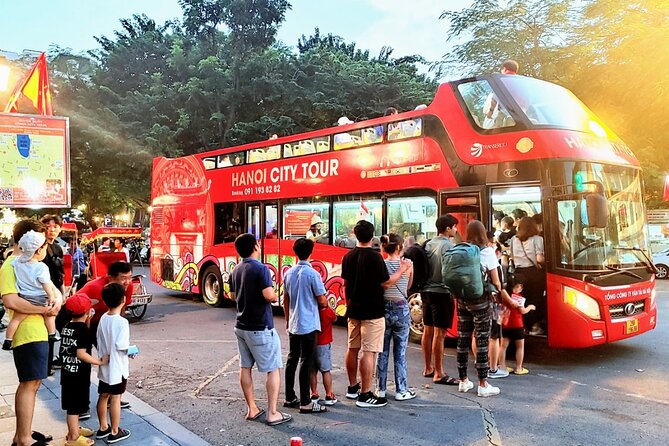
Your start point is Dong King Nghia Thuc Square, No 7 Dinh Tien Hoang. That matters, because the tour does not include hotel pickup or airport pickup/drop-off. Near public transportation is helpful, but you’ll still want to plan how you’ll get to that square before your ride begins.
Also keep your expectations realistic at the ticket box. Some riders have run into slow ticket verification at the meeting area. If you’re trying to be efficient, give yourself a little buffer so you’re not rushed when you’re ready to hop on.
Comfort matters in Hanoi heat and rain

I like that the tour is built for Hanoi’s weather swings. You get a conical hat and rain coat onboard, which sounds small until you’re standing at a curb during a downpour with nowhere to hide. On muggy days, the air-conditioning helps you stay fresh enough to actually enjoy the stops instead of just surviving them.
Then there’s the water approach. The operator supplies a 20-liter water container and provides paper cups so you can refill without buying a bunch of single-use bottles. If you bring your own reusable bottle, you’ll be set for the whole day. WiFi on board is also useful for checking directions when you hop off and want to confirm where you are before walking back to the bus.
Stop-by-stop: how to plan each hop for maximum value
Here’s the real reason hop-on hop-off works well in Hanoi: you can match each stop to your mood—churches for architecture, pagodas for quiet, museums for context, and colonial-era landmarks for that French-era texture.
1) St. Joseph Cathedral: French-era architecture you can enjoy fast
St. Joseph Cathedral is a huge highlight near the center of town. Built in 1884, it opened in December 1886 under French colonial rule, and it’s described as resembling Notre Dame de Paris. It’s also labeled as the oldest church in Hanoi, and the tour notes that there is no entrance fee.
Why I think it’s worth your time: you can get a meaningful dose of French colonial Hanoi without committing to a museum ticket. Even if you’re not religious, the scale and façade are exactly the kind of landmark that helps you understand the city’s layered past quickly.
Practical tip: plan a short stop here for photos and a quick look inside if open, then move on—this area is compact and easy to walk around.





2) Vietnam Military History Museum area and the Flag Tower detail
Stop 3 focuses on the Vietnam Military History Museum area, and it comes with an important nearby reference point: the Flag Tower of Hanoi. The tower is noted as one of the rare works in the Hanoi Citadel that was not destroyed during French domination between 1894 and 1897. It’s also described as having existed for nearly 200 years.
Why it matters: even if you don’t go deep into every exhibit, this is a useful pivot from colonial-era structures to imperial and revolutionary symbolism. It helps you “read” the city as a place where power shifted over centuries, not just a list of pretty buildings.
3) Ho Chi Minh Mausoleum and Ba Dinh Square: a political center you can’t ignore
At Stop 4, you reach Ho Chi Minh’s Mausoleum in Ba Dinh Square. The tour description frames it as the resting place of revolutionary leader Ho Chi Minh and notes his role as President and Chairman of the Workers’ Party, including that he read the Declaration of Independence on 2 September 1945.
Even if you’re more interested in architecture or food than politics, Ba Dinh Square is an anchor point. It’s where Hanoi’s modern national story is physically staged—big, formal, and impossible to miss.
4) One Pillar Pagoda: minimal fee, iconic shape, quick payoff
Stop 5 is One Pillar Pagoda. The structure is described as a building laid on one pillar, with an original pagoda built in 1049 and later additions, then perfected in 1105. It’s considered one of Vietnam’s two most iconic temples, and the tour notes no entrance fee.
This is one of those stops where you get instant payoff. The structure is instantly recognizable, and the fact that there’s no entrance fee means you can keep your day flexible—hop on, see it, and keep going.
5) Tran Quoc Pagoda: old Hanoi with serious age
Stop 6 is Tran Quoc Pagoda, described as the oldest pagoda in Hanoi. The tour dates its original construction to the sixth century, during Emperor Ly Nam De’s reign (544 to 548), putting it at more than 1,500 years old.
If you like places that feel like they’ve outlasted fashion and politics, this is your kind of stop. It’s not about spectacle; it’s about age and continuity.
6) Cua Bac Church area: French planning meets Roman Catholic life
Stop 7 is tied to Cua Bac Church. The church was built in 1932 by the French administration of Indochina as part of Hanoi’s urban plan supervised by Ernest Hébrard. Today, the tour notes it’s one of three major churches in Hanoi, along with Ham Long Church and St. Joseph Cathedral.
Why it’s interesting: it’s a reminder that Hanoi’s French influence wasn’t only about government buildings—it shaped the city’s planning and religious architecture too.
7) Quan Thanh Temple: Taoist symbolism and the Four Sacred Temples idea
Stop 8 is Quan Thanh Temple, established during Emperor Ly Thái Tô’s reign (1010–1028). It’s dedicated to Tran Vu, a Taoist deity of the North, and the tour description highlights symbols of power: the serpent and turtle. It’s also described as one of the Four Sacred Temples built in four directions to protect the capital from malevolent spirits.
This stop is for you if you like meaning beyond the stones. The “north protection” idea and the animal symbolism help you see the temple as part of a larger mental map people once used to protect the city.
8) Imperial Citadel of Thang Long: independence in layers
Stop 9 is the Imperial Citadel of Thang Long. The tour notes it was built in the 11th century by the Ly Viet Dynasty to mark Dai Viet independence, constructed on the remains of an earlier Chinese fortress dating from the 7th century. It also mentions the citadel was built on reclaimed land drained from the Red River Delta.
This is the stop where you understand Hanoi as a city stacked on top of history. If you’re short on time, even the outdoor sense of the citadel area is useful, but if you want deeper access, note the entrance fee listed for the citadel.
9) Temple of Literature: Confucius plus Vietnam’s first national university
Stop 10 is the Temple of Literature, or Van Mieu, dedicated to Confucius. The tour description adds that the site also hosted the Imperial Academy—Vietnam’s first national university. It was built in 1070 under Emperor Ly Thanh Tong.
This is a great stop for anyone who enjoys learning and architecture with purpose. The “education history” angle adds extra weight: it’s not just a shrine; it’s a former academic center.
10) Hoa Lo Prison: the “Hanoi Hilton” gatehouse museum
Stop 11 is Hoa Lo Prison. The tour explains it was used by French colonists for political prisoners, then later by North Vietnam for U.S. prisoners of war during the Vietnam War. During that period it was known to American POWs as the Hanoi Hilton. The prison was demolished in the 1990s, but the gatehouse remains as a museum.
This stop can feel heavy, and that’s the point. If you want context for the Vietnam War beyond headlines, this is one of the places that anchors the story in physical space.
11) Vietnamese Women’s Museum: social change told through artifacts
Stop 12 is the Vietnamese Women’s Museum. It officially opened in 1995 and is operated by the Vietnam Women’s Union. The tour notes a collection of more than 40,000 materials and artifacts, plus permanent exhibits and thematic exhibitions using an approach tied to social anthropology—tracking development and change in contemporary society, including projects focused on vulnerable women and disadvantaged children.
If your trip leans beyond landmarks into human stories, this is a strong add-on. It’s also a smart break from outdoor walking because museums let you slow down without losing the day.
12) Hanoi Opera House: French elegance built between 1901 and 1911
Stop 13 is Hanoi Opera House, also called the Grand Opera House. The French colonial administration erected it between 1901 and 1911. The tour notes it’s one of three opera houses the French built in Indochina, with the others in Haiphong and Ho Chi Minh City.
Even if you never go inside, the building is useful for understanding the “civilizing” architecture French authorities tried to install—something formal and European in the middle of Hanoi.
13) Hanoi Post Office: the “Post office by the lake” symbol
Stop 14 is at 75 P. Đinh Tiên Hoàng, the Hanoi Post Office. It’s described as a symbol of the capital, designed and built by Henri Vildieu from 1894 to 1899. The tour also mentions it has had 125 years of existence with the familiar name Post office by the lake, and it has a neoclassical architectural style.
This is a great ending stop because it’s both practical and photogenic. If you want to mail a postcard or just look at the space, it’s an easy way to wrap up your circuit.
Audio, schedules, and what to watch for when things get messy
The tour includes English audio, and on good days it’s a smooth way to connect what you’re seeing to context. In practice, though, you’ll want to stay alert. Some riders report the audio not always lining up perfectly with where the bus is at that moment.
More broadly, the operator warns that the route and schedule can change suddenly because of traffic issues, public holidays, weather, or unforeseen circumstances. Reduced frequency, delays, or route alterations can happen. That means you should build your day around flexibility, not strict clockwork.
One more practical note drawn from the reality of hop-on hop-off tours: the bus may not stop right where you expect, and some attractions require a short walk from the stop. Near higher-security or major landmark areas—like the Mausoleum zone and Hoa Lo Prison—the stop location and timing feel extra important. I’d rather you arrive calm than sprint.
If you do experience a broken audio system or cleanliness problems on a specific bus, don’t just wait it out. Ask staff how to switch buses if the service isn’t working the way it should.
Who this tour is best for (and who should choose something else)
This hop-on hop-off route is ideal if:
- You’re in Hanoi for a short time and want a wide overview without committing to one fixed guided walk.
- You like mixing big “A-list” sights (pagodas, citadel, museums) in one plan.
- You want comfort during transfers, thanks to air-conditioning and onboard WiFi.
You might choose something else if:
- You hate paying separate entrance fees for multiple stops (since several are not included).
- You want a tightly controlled, guaranteed-on-the-minute schedule.
- You prefer slow, deep guided interpretation for just one neighborhood rather than a fast sampler across the city.
Should you book this Hanoi hop-on hop-off bus tour?

Yes, I’d book it if you want a smart way to get your bearings and cover a lot of Hanoi without exhausting yourself. The $20 price makes sense because you’re not just buying transport—you’re buying comfort, WiFi, water support, and an English explanation that helps you understand what you’re looking at.
That said, don’t treat the day like a timetable. Build in patience for traffic-driven route changes, and plan for extra time at major landmark areas. If your goal is maximum inside access, also budget for the entrance fees listed for several stops.
If you want, tell me your travel dates and what you most care about—war history, temples, French architecture, or museums—and I’ll suggest a tight “hop plan” for how to use the bus stops in the most efficient order.
You Might Also Enjoy



More Full-Day in Hanoi
- Ninh Binh Full-Day Tour from Hanoi to Hoa Lu, Tam Coc & Mua Cave Via Boat & Bike
★ 5.0 · 4,384 reviews



More Tours in Hanoi
- Ninh Binh Full-Day Tour from Hanoi to Hoa Lu, Tam Coc & Mua Cave Via Boat & Bike
★ 5.0 · 4,384 reviews